Ain’t No April Fools Joke April 2, 2010
Posted by shawnpci in Fire Systems, FSSA.Tags: Data Centers, Fire Systems, FSSA
add a comment

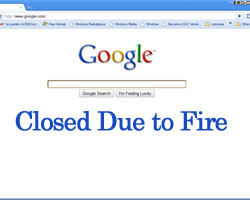
To quote Jerry Garcia…”what a strange trip it’s been.”
Rarely have two events conspired on the same day to bring into sharp focus the reality of our electronic connectedness: Google Data Center Fire and Windstream Outage.
Both unfortunate situations point out just how vulnerable we are in the electronic age. Despite what I’m sure were days if not months of planning and double checking, the systems put in place to safeguard systems and facilities failed.
In the Google case, not only was the giant brought to its technical knees, it’s being financially tormented by its advertisers.
With the Windstream outage, emergency 9-1-1 centers in Nebraska as well as a UL-listed central alarm monitoring station were literally disconnected from their constituents. The impact to public safety wasn’t limited to just the Nebraska counties affected, but the numerous central station customers locate throughout the Midwest.
Readers of my blog know that I’m all about good reliable fire protection, however, as both cases point out – it can’t hurt to consider the true total cost of ownership when assessing fire protection options in a data center or the reliability/redundancy of monitored services.
Stupid Is As Stupid Does March 19, 2010
Posted by shawnpci in Fire Systems, FSSA.Tags: Fire Systems
add a comment
I’m learning the ropes with this Web 2.0 stuff.
I want to start adding video clips to my blog for illustrative purposes on a variety of subjects. So, I signed up for a You Tube account and am starting to upload some short clips that I’ll share in coming blogs.
However, whilst on You Tube, I came across this disaster of a clip supposedly showing how a clean agent system discharges.
For the love of God, PLEASE DO NOT try this at home, office or business. This is NOT the way to handle, store, or activate a clean agent system. This dude is very lucky the cylinder, hose, pipe and nozzle didn’t break loose and scatter across his shipping floor.
To my friends in the industry, let’s find this guy and encourage him to join our trade group, the Fire Suppression Systems Association, so he can learn how not to handle pressurized cylinders.
Iowa Governor Signs Fire Protection Licensing Changes Into Law March 13, 2010
Posted by shawnpci in Fire Systems.Tags: Fire Systems
add a comment
Iowa governor, Chet Culver (D), signed Senate File 2355 into law this week. These changes correct numerous problems with previous attempts to license fire protection installers in Iowa.
Most notably, there are now separate tracks to follow for those who install water-based fire sprinkler systems, special hazard systems and pre-engineered systems. Previous versions of the law didn’t differentiate between technologies and left several loopholes that created enforcement problems.
Now, with passage of this law, the Iowa State Fire Marshal’s office will have a much better set of rule and regulations to enforce throughout the state.
To read the law, follow this link:
Stay tune for more details as this licensing law begins to take effect.
Michigan Clean Agent System Seen As Waste of Taxpayers Money February 27, 2010
Posted by shawnpci in Fire Systems.Tags: Fire Systems
add a comment
As an advocate for my industry, I have a hard time with this one…
Michigan State Representative, Rick Jones, R- Grand Ledge, has criticized the newly opened Michigan State Police facility in Lansing, Michigan as a “boondoggle and a waste of taxpayers money.”
According to detNews.com on a February 25. 2010 post, “a digital evidence room had to be redone and special fire suppression equipment installed so that, in the event of a fire alert, evidence and equipment would not be damaged by water from sprinklers.”
I say good for Michiganders and those with foresight to use clean agents in a responsible manner. Apparently this type of extravagance in protecting critical documents and evidence from fire and water ruin is too much for the representative to handle.
I know times are a bit tough nowadays, but I think it calls for more attention to critical priorities and their proper protection. Yes, clean agent systems are more expensive that basic water fire protection, but in applications such as this I ask – expensive compared to lost or damaged critical evidence?
Here’s a link to the article:
http://www.detnews.com/article/20100225/METRO/2250396/1409/metro/Michigan-State-Police-begin-move-to-facility-criticized-for-its-cost#ixzz0gm98rY7G
Technical Nirvana Achieved at FSSA Meeting February 23, 2010
Posted by shawnpci in Fire Systems, FSSA.1 comment so far
A technical nirvana of sorts was had during a presentation by FSSA’s Technical Committee Director, Dan Hubert. Dan spoke eloquently about the numerous technical publications available through the Association. Most of the 161 industry leaders in attendance had not had the opportunity before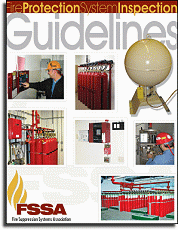 this meeting to delve into the various manuals developed by the Technical Committee.
Starting with FSSA’s Inspection and Test Guide, Dan reviewed how this latest publication leads an inspector through the details of properly and professionally conducting a special hazards system inspection.
Time was also spent discussing other FSSA publications including:
- FSSA Pipe Design Handbook, which is referenced in several NFPA standards
- FSSA Cylinder Handling Guide
- FSSA CO2 Rate by Volume Calculation Guide
and one of the more recent publications, the FSSA Pressure Relief Vent Area Guide and Software Bundle. This is a “must have” for anyone working with Clean Agent Fire Suppression Systems since now NFPA 2001 requires relief vent calculations to be provided on all project drawings.
Check out FSSA web-site at: www.fssa.net
The FSSA Annual Meeting continues through February 23rd.
Iowa HSB564 Legislation Being Considered February 1, 2010
Posted by shawnpci in Fire Systems.add a comment
The Iowa Legislature is considering amendments to the fire sprinkler installers legislation that will provide clarity to efforts to regulate fire protection system installers.
Many of the changes in the proposed legislation came about as a result of a public hearing on proposed rules regulating fire protection system installers. In addition, the Iowa State Fire Marshal’s office convened a group of interested parties to review specific changes.
Persons interested in this legislation should be encouraged to register for bill tracking at the Iowa Legislatures web site: http://www.legis.state.ia.us/index.html
Does NFPA 70E Apply to Fire Alarm Technicians Performing Final Hook-ups And Panel Testing? January 21, 2010
Posted by shawnpci in Fire Systems.Tags: NFPA
add a comment
I usually don’t rant – but in this case I’m making an exception:
Our fire alarm technicians got kicked off a job-site today because they were not wearing NFPA 70E Arc-Flash protective gear and had not completed 10 hour NFPA 70E training class.
They were at a fire alarm control panel performing final low-voltage circuit wiring terminations and panel programming. 120VAC was present in panel with panel door open. General Contractor’s job-site safety officer cited them for non-compliance and kicked them off job until they show proof of training and are appropriately dressed.
I’ve been in this racket for 25 years now and this is a new one on me.
Would appreciate any feedback or insights on why such extreme safety measures must be taken with a 24vdc control panel.
There, I’ve got it off my chest. I’m still not happy, though.
If you happen to have some insights or thoughts, let me know. I’d be very interested to know of them.
Testimony before the Iowa State Fire Marshal regarding rules implementing Iowa Acts 2008 Chap. 1094 as amended by Iowa Acts 2009 House File 400 October 13, 2009
Posted by shawnpci in Fire Systems.Tags: fire, NFPA, Protex Central
comments closed
Thursday, October 15, 2009
Des Moines, IA
Good morning. My name is Shawn Mullen. I appear this morning on behalf of my company, Protex Central, Inc. – a 43 year-young systems integrator specializing in fire, security and related systems. As president of Protex Central, I oversee an enterprise of more than 50 employees located in offices in Urbandale, Iowa and three locations in Nebraska.
I am a 24-year veteran of the fire systems industry. I am certified by the National Institute for Certification of Engineering Technicians – commonly known as NICET – at its highest level IV in the fire alarm sub-field and at level III in the special hazards sub-field. As such, I am our company’s responsible managing employee, as required by Iowa statue, for our certification as a fire alarm and as a fire extinguishing contractor.
In addition to my responsibilities with Protex Central, I am immediate past-president of the Fire Suppression Systems Association. The FSSA is an international trade association of fire system equipment manufacturers and installers, like Protex Central, who promote the use of, and seek to be the leading recognized authority on, special hazard fire protection systems; employing existing and new technologies to safeguard people, high-value assets and the environment.
In addition to my involvement with the FSSA, I’m a member of the National Fire Protection Association, the National Burglar and Fire Alarm Association, the National Independent Fire Alarm Distributors and the National Systems Contractors Association.
I have been a member of the Iowa State Fire Marshal’s Contractor’s Advisory Board since its inception in July of 2005. I was recently reappointed to another four year term. During my time on the board, I have been active and involved with the rules making process implementing both the fire extinguishing contractors licensing and the alarm contractors’ licensing laws.
The Proposed Regulations: New Chapter 276 to Iowa Administrative Code, “Fire Protection Installer and Maintenance Worker Licensing” appear to apply to individuals who install or maintain fire suppression systems that are not within the scope of “fire protection systems” as that term is defined in Chapter 100D of the Iowa Code. The proposed regulations define five separate endorsements:
• Automatic fire sprinkler system installation and maintenance
• Special hazards fire suppression system installation and maintenance
• Installation and maintenance of pre-engineered dry chemical or wet agent fire protection systems
• Installation and maintenance of pre-engineered water-based fire protection systems in one- and two-family dwellings
And
Any combination thereof.
I submit that the special hazard fire suppression systems and pre-engineered dry chemical or wet agent systems endorsements are not within the scope of “fire protection systems” that the Legislature has authorized the State Fire Marshal to regulate pursuant to Chapter 100D.
Section 100D.1(4) of the Iowa Code defines a fire protection system as follows:
“Fire protection system” means a sprinkler, standpipe, hose system, special hazard system, dry systems, foam systems, or any water-based fire protection system, either manual or automatically activated, used for fire protection purposes that is composed of an integrated system of underground and overhead piping connected to a water source. For licensing purposes only “fire protection system” does not include the water service piping to a structure or building from a city water main.”
To be clear, the systems to be addressed by the special hazards fire suppression systems installation and maintenance endorsement of the proposed regulations are not connected to a water source. In fact, these types of special hazard systems use non-water extinguishing agents such as dry chemical, wet agent, carbon dioxide, inert gases, halogenated agents such as Halon 1301, halocarbon clean agents such as FM-200 and fluorinated ketone agents such as Novec 1230.
Clearly, special hazard fire suppression systems using non-water extinguishing agents are not “fire protection systems” as defined in Chapter 100D and are thus are beyond the scope of Chapter 100D and its licensing requirements.
I, therefore, respectfully submit that subsection (b) of section 276.1(2) of the proposed regulations be deleted.
Additionally, subsection ( c) of section 276.1(2) should be deleted since pre-engineered dry chemical and wet agent fire suppression systems are not “connected to a water source” and thus beyond the scope of Chapter 100D and its licensing requirements.
However, should these subsections remain as part of the proposed regulations, I wish to point out several issues that adversely affect the installation and maintenance of special hazard systems.
It is important to remember that several of the agents, and devices used in these special hazard systems are under close scrutiny and supervision from various agencies of the federal government including the Occupational Safety and Health Administration, the Department of Transportation, The Bureau of Alcohol, Tobacco and Firearms and the Environmental Protection Agency. The mis-handling or mis-application of these agents or devices may have harmful affects on both personnel and the environment.
Regarding Exceptions 1 and 2 of the endorsement for special hazards fire suppression system installation and maintenance, the threshold of 8500 hours or more of employment is simply too long and not logical or based upon any factual industry reference.
A more reasonable threshold of 4000 hours is feasible and relative to the very reference of Level I NICET special hazards sub-field certification that must accompany this exception. Moreover, this threshold parallels training and work experience that most special hazard fire equipment manufacturers and contractors provide to new technicians entering this important sub-field of the fire protection industry.
I submit this same timeframe be adopted for Exceptions 1 and 2 of the endorsement for pre-engineered dry chemical and wet agent fire protection systems.
Regarding section 276.1(4) application fees, consideration must be given to special hazards endorsement applicants since special hazard systems incorporate a low-voltage electrical detection and control system for supervision and activation.
Persons performing installation, testing and maintenance on these alarm systems are currently regulated under Iowa Code 100C. Iowa Code 100C already requires fees including a mandatory FBI background check.
Requiring yet another FBI background check for special hazards endorsement applicants is redundant, provides no greater level of security to the public and presents an undue burden on the applicant and his or her employer. To underscore this redundancy another way, some actuation devices used to release special hazards agent containers are now regulated by the Bureau of Alcohol, Tobacco and Firearms. ATF requires persons handling these regulated devices be subjected to the very FBI background check required by these regulations.
I recommend that the State Fire Marshall revise the proposed fee structure for the special hazards endorsement to be $150 for a two-year license and credit be given for the FBI background check already on file as a result of the Chapter 100C requirement. This revised amount when annualized and added to the annualized amount for the alarm installer’s license would be equal to the annualized amount for the other endorsements of Chapter 276.
Currently, these proposed rules and regulations appear to draw very clear distinctions between each of the individual endorsements. These distinctions are very important. Each should stand on its own. Allowing reciprocity among the endorsements could place persons and property at risk from errors and mis-understanding of how the systems are designed and how they must be inspected and maintained.
For example, technicians qualifying for the special hazards endorsement are not exposed to the hydraulic considerations, installation techniques nor the mechanical operations of automatic fire sprinkler systems. Conversely, qualified fire sprinkler installers are, most likely, not licensed to inspect or maintain detection and control systems nor are they continuously aware of the various regulations from OSHA, ATF, the Department of Transportation, and the EPA that impact various special hazard systems.
I strongly recommend that the State Fire Marshal not consider the requirements for licensure as an automatic fire sprinkler installer as qualifying for the endorsements for special hazards or pre-engineered dry chemical or wet agents. To do so may well jeopardize the very safety and security these regulations seek to provide to the citizens of Iowa.
Lastly, please know that I am happy to provide a copy of these comments to the State Fire Marshal’s office and am available to provide additional background information as well as technical references on any of the noted items. Thank you for this opportunity to comment on these proposed rules and regulations.
Clean and Green Demo Slated for Oct 14th October 3, 2009
Posted by shawnpci in Fire Systems.Tags: fire, NFPA, Protex Central
add a comment


 The next Clean and Green Fire Suppression demonstration is schedule for Wednesday, October 14, 2009 from 12:00 p.m. to 1:00 p.m. at the Urbandale, IA offices of Protex Central.
We’ll cover topics ranging from uses, applications and regulations relating to clean agent fire protection.
The live fire suppression demonstration will take place in our full-functioning demonstration room and feature 3M’s NOVEC 1230 Fire Protection Fluid.
It’s a demonstration that you won’t want to miss.
Seating is limited so RSVP today!
Contact Protex Central at (800) 274-0889 or shari.mullen@protexcentral.net
Iowa Acts Chapter 1094 Effective August 1, 2009 July 24, 2009
Posted by shawnpci in Fire Systems.Tags: fire
add a comment

I’m concerned about the implementation of Iowa Acts Chapter 1094 – Regulation and Licensure of Fire Protection Installation and Maintenance.
This law is set to take effect on August 1, 2009.
I believe that this law’s implementation may adversely affect a business’ ability to attract and retain future technical employees. Specifically, while it may appear the law deals with water-based fire protection system installers, I believe it may adversely affect individuals involved with installing, testing, or maintaining any type of fire suppression system. My understanding is that this includes systems such as pre-engineered wet-agent fire suppression systems as well as clean agent fire extinguishing systems.
While I have several issues with the law as written, my main concern centers on the law’s mandatory requirements for new employees to:
• Be an apprentice sprinkler fitter
• Complete four years in a Dept. of Labor approved apprenticeship program
• Pass the Star fire sprinkler mastery exam or an equivalent exam or be NICET certified at level I
As of now a public hearing on the rules and regulations pertaining to this law is yet to be scheduled. I was given to understand that in order for the rules and regulations to be in effect by January 1, 2010 an August public hearing date would be necessary.
A draft of the proposed rules and regulations has not been issued yet. You may want to monitor the Iowa State Fire Marshal’s web site for updates on the public hearing date as well as release of the proposed rules and regulations.
I am a member of the Fire Extinguishing Contractor’s Advisory Board to the Iowa State Fire Marshal. The board is not empowered by this law to provide input to the Fire Marshal. However, I know that Fire Marshal Jim Kenkel is interested in feedback and input on proposed rules and regulations from all citizens especially at public hearings.
The next board meeting is scheduled for 10:00 a.m., Wednesday, August 12, 2009 at the Department of Public Safety Building at 217 East 7th Street in Des Moines.
I urge you to take time to review this information and get involved with this most important issue.


 Onward and Upward