Wind Turbine Fire Reality January 11, 2009
Posted by shawnpci in Fire Systems.Tags: Protex Central, wind turbines
1 comment so far
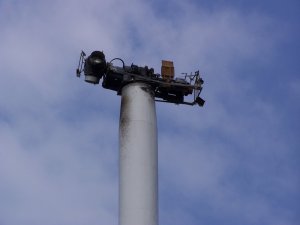
One of my favorite definitions of a “low” fire hazard is: “A concrete vault, six feet under water.” By that definition, wind turbines could be considered fire hazards: they’re neither concrete nor six feet under water.
A quick look around the internet yields many a reference to wind turbine fires. Check out some of these links:
Bloomfield, NE wind turbine fire story and video
Bloomfield, NE wind turbine aftermath
Spanish wind turbine fire video
Palm Springs, CA wind turbine fire video
I’ve been on a bit of a cause of late, like Don Quixote, to find a willing participant in the wind industry that’s interested in fire protection for wind turbines.
I’ve made a couple of stabs with the energy companies and a manufacturer, but my inquiries have fallen on deaf ears. I actually had the opportunity to climb two towers and tour the interior of the nacelles (the box that can burn on top of the 210′ stick – see photo of what once was a nacelle above).
I’ve developed solutions for both fire suppression as well as fire detection in these hazard areas. I’m looking for an opportunity to promote them to the industry.
So, if you know of a good contact that I can trot off to see, drop me a line at shawn.mullen@protexcentral.net. Or if you’ve got other good references of wind turbine fire hazards, pass them along, too. TX!
Tracking Explosions Just Got Easier January 1, 2009
Posted by shawnpci in Fire Systems.Tags: dustexplosions, explosions, Fenwal, NFPA, Protex Central
add a comment
One of the special systems that Protex Central services and maintains is an explosion protection system designed and manufactured by Fenwal Safety Systems, a division of United Technologies.
Operating primarily in the grain rich area of the middle west, we have several applications that are protected with such systems. I recently came across a site that collects and tracks various dust fires and explosions from around the world.
Click here to follow the link: dustexplosions.blogspot.com
All too often, many of these situations could have been minimized or even avoided with the use of properly designed and installed explosion protection systems.
The National Fire Protection Association develops codes and standards related to explosion protection. You can learn more at their web site: www.nfpa.org


 Onward and Upward